
What is Asset-Based Community Development?
Key Elements of ABCD with Stories from my Development Efforts

The ABCD Institute defines Asset-based Community Development this way, “ABCD practitioners consider local assets as the primary building blocks of sustainable community development. Building on the skills of local residents, the power of local groups, and the supportive functions of local organizations, asset-based community development draws upon existing community strengths to build stronger, more resilient communities for the future.”
What distinguishes Asset-Based Community Development (ABCD) from other forms of development? In Embrace’s Power Shift Training Series, we name four bedrock principles that are foundational to ABCD.
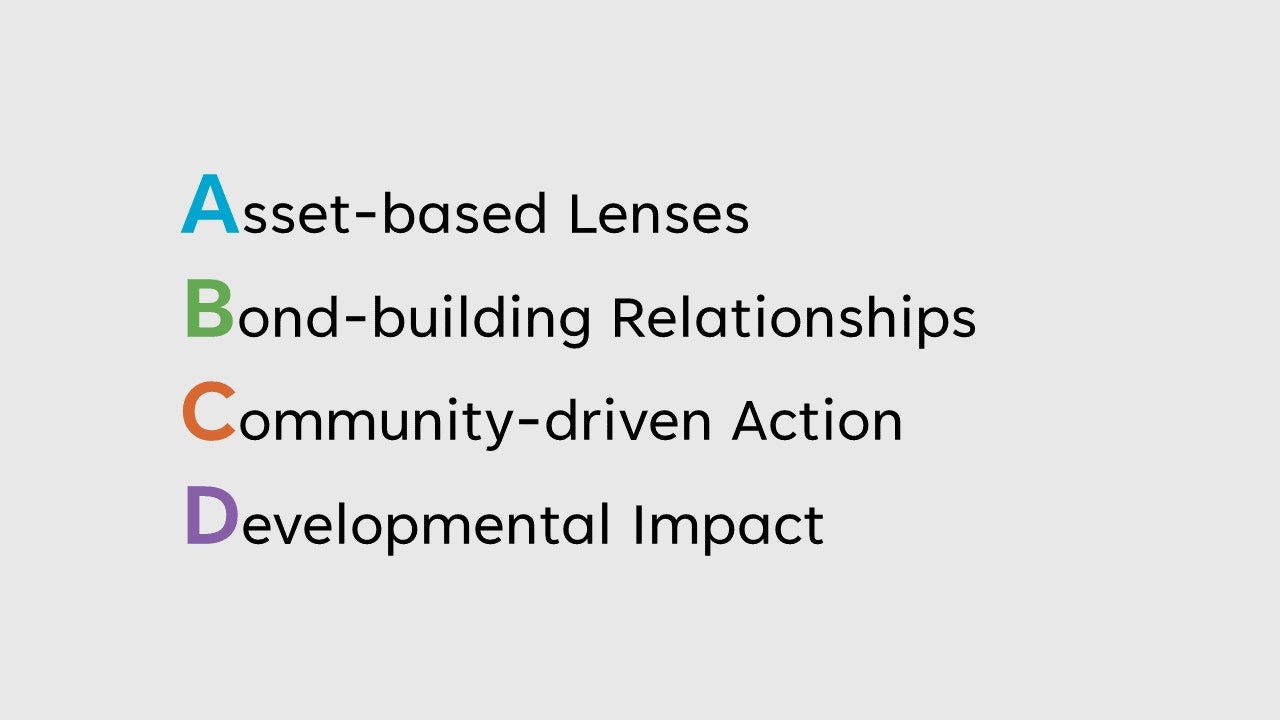
Asset-based Lenses: The belief that building on assets (not deficits) leads to stronger and more resilient communities.
Bond-building Relationships: The belief that a strong community is marked by relationships of care among community members and that strengthening these peer-to-peer connections strengthens the community as a whole.
Community-driven Action: The belief that the community members themselves know how best to strengthen their community and that they should define and be in control of the development effort, with outside institutions providing support if requested.
Developmental Impact: The belief that strong communities are those that use their own collective power and assets to achieve self-defined goals. In short, a successful ABCD effort grows the capacity of a community to shape its own future.
These principles are shaped by a commitment to four values:
Value the small
Include everyone
Believe in possibility
Work for equity and justice
These values and principles foster a healthy ABCD approach. These principles and values are drawn from the ABCD Institutes “Values behind ABCD.”
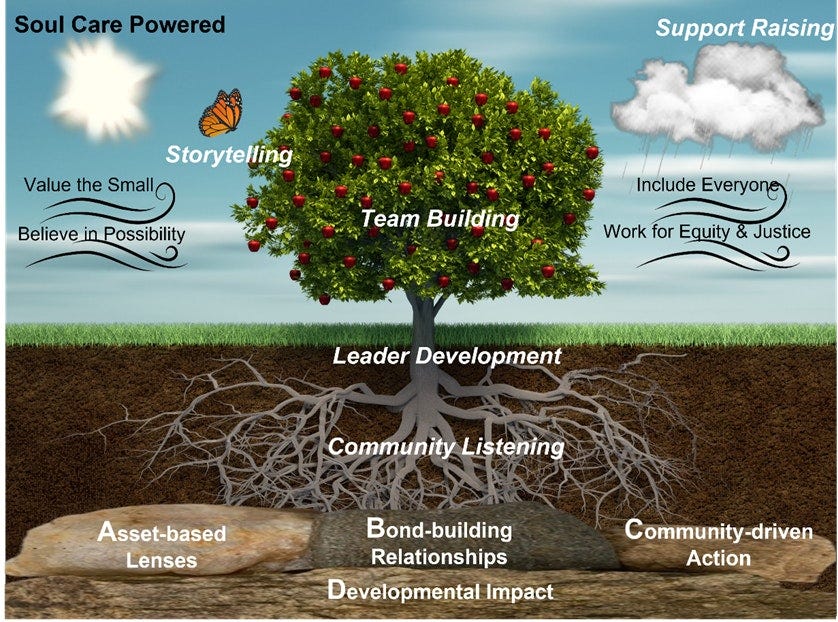
The five capacity building processes named in Power Shift help to cultivate communities that embody these values and principles. These processes are community listening, leadership development, team building, support raising, and storytelling. Below is a visual designed to help capture these various elements.
We refer to this framework as the CommUnity-Powered Framework. Within the broader ABCD network, there are multiple frameworks. However, if you examine them all closely you will find the same elements, just named and visualized differently.
Many of these principles, values, and processes are also found in other adjacent movements that are seeking to strengthen communities from the inside out.
As you look at your own development effort, can you see evidence of these four principles at work?
Is your own community cultivation effort shaped by these values?
Have you developed processes like these to cultivate a stronger resilient community?
If you are new to ABCD and would like to learn more, we encourage you to check out our Power Shift self-guided course. Power Shift Part 1 is a deep dive into these principles and values, and Power Shift Part 2 is an implementation guide to help you cultivate the five capacity-building processes.
The videos below are used in our Power Shift training and illustrate ABCD in action. All are from my personal development efforts in communities across Richmond, Virginia.
The Hillside Court Story as told by Lindsay Gulatte-Lee
The Brookland Park Story as told by as told Laverne Winfree (aka Mamma Winfree) and Yvonne Tunstall (aka Mrs. T)
Griffin Block Club Story: As told by Anita Johnson
Northminster Church Story: As shared by Pastor Williams, church members and Brookland Park residents
Broadwater Story: As shared by community youth and their supporters from Chester UMC
You can find many more stories in our Network Newsroom. Member Spotlights
and at the ABCDI website.
This is a concise and informative article on ABCD. Thank you.